
The trifascicular block confusion
One term but not one diagnosis. Time to stop using it.

Ask three clinicians what “trifascicular block” means and you can comfortably get three different answers. One says bifascicular block with a long PR. Another points to an ECG where the QRS morphology alternates between RBBB and LBBB. A third says block in all three fascicles at once, which is just complete heart block. None of them is wrong. That’s the problem.
When you have two or more not-wrong definitions of a single term, the term has to go. In the US of A, the 2009 AHA/ACCF/HRS standardisation committee recommended abandoning the term “trifascicular block”[1].
The term lacks specificity. To communicate effectively in medicine, you need to be specific.
The anatomy
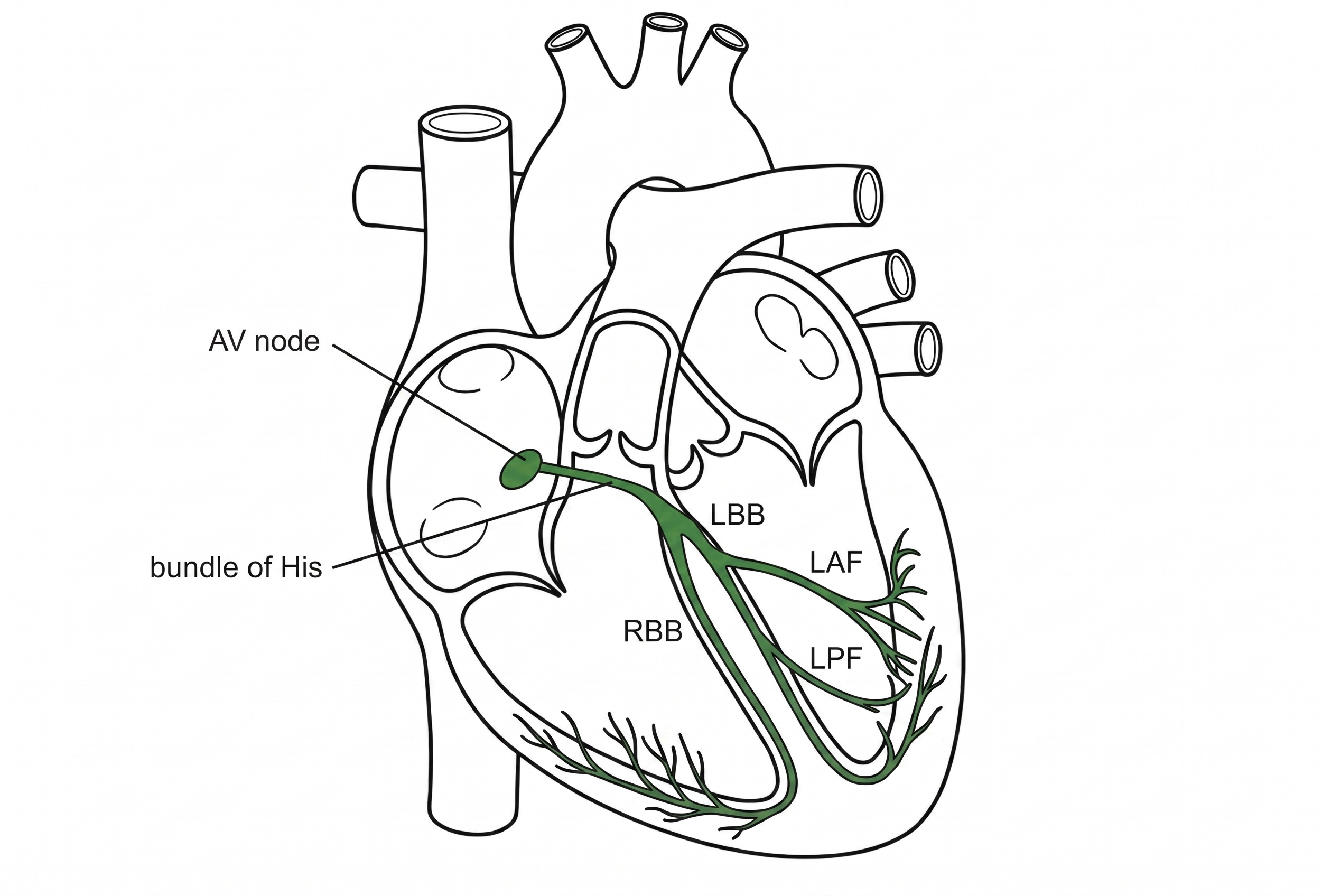
Below the AV node, the conduction system splits into three branches:
the right bundle branch (RBB)
the left anterior fascicle (LAF) of the left bundle branch
the left posterior fascicle (LPF) of the left bundle branch
Three branches. The AV node and the His bundle sit upstream of the split and are not fascicles. This matters because the most common use of “trifascicular block” treats the AV node as the third fascicle. It’s not a fascicle.
What can fail
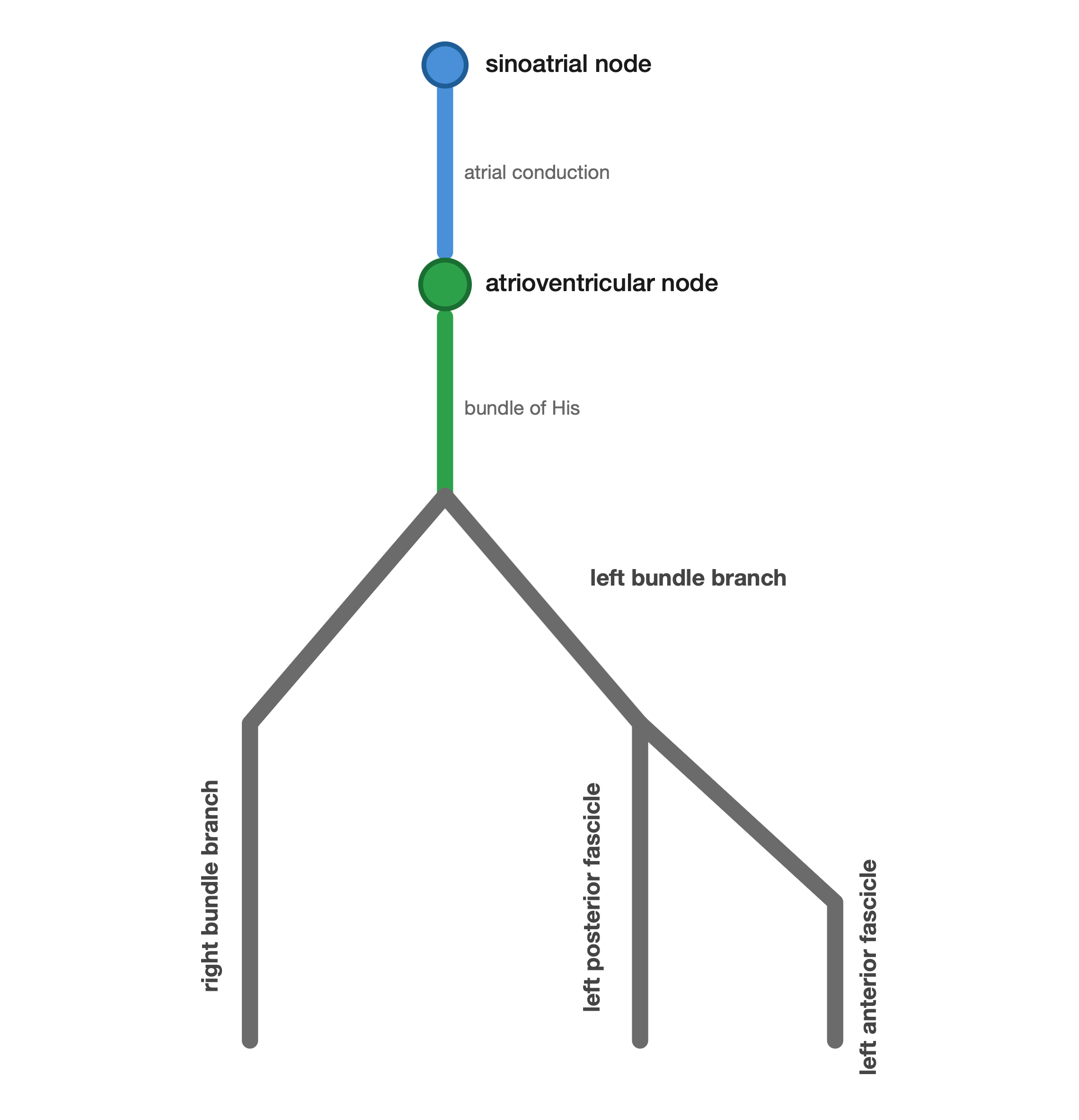
Conduction can fail anywhere along this system, and the pattern of failure determines what you see on the ECG.
Above the branching point (AV block):
First-degree (long PR)
Second-degree (Mobitz I, Mobitz II, 2:1, high-grade)
Third-degree (complete heart block)
Most of these reflect AV nodal disease. Mobitz II and high-grade block are the exception: they usually sit below the AV node (infranodal, in the His-Purkinje system). That makes those two the dangerous ones; infranodal escape rhythms are slower and less reliable than junctional escapes.
In a single branch:
Right bundle branch block (RBBB)
Left anterior fascicular block (LAFB)
Left posterior fascicular block (LPFB)
Left bundle branch block (LBBB)
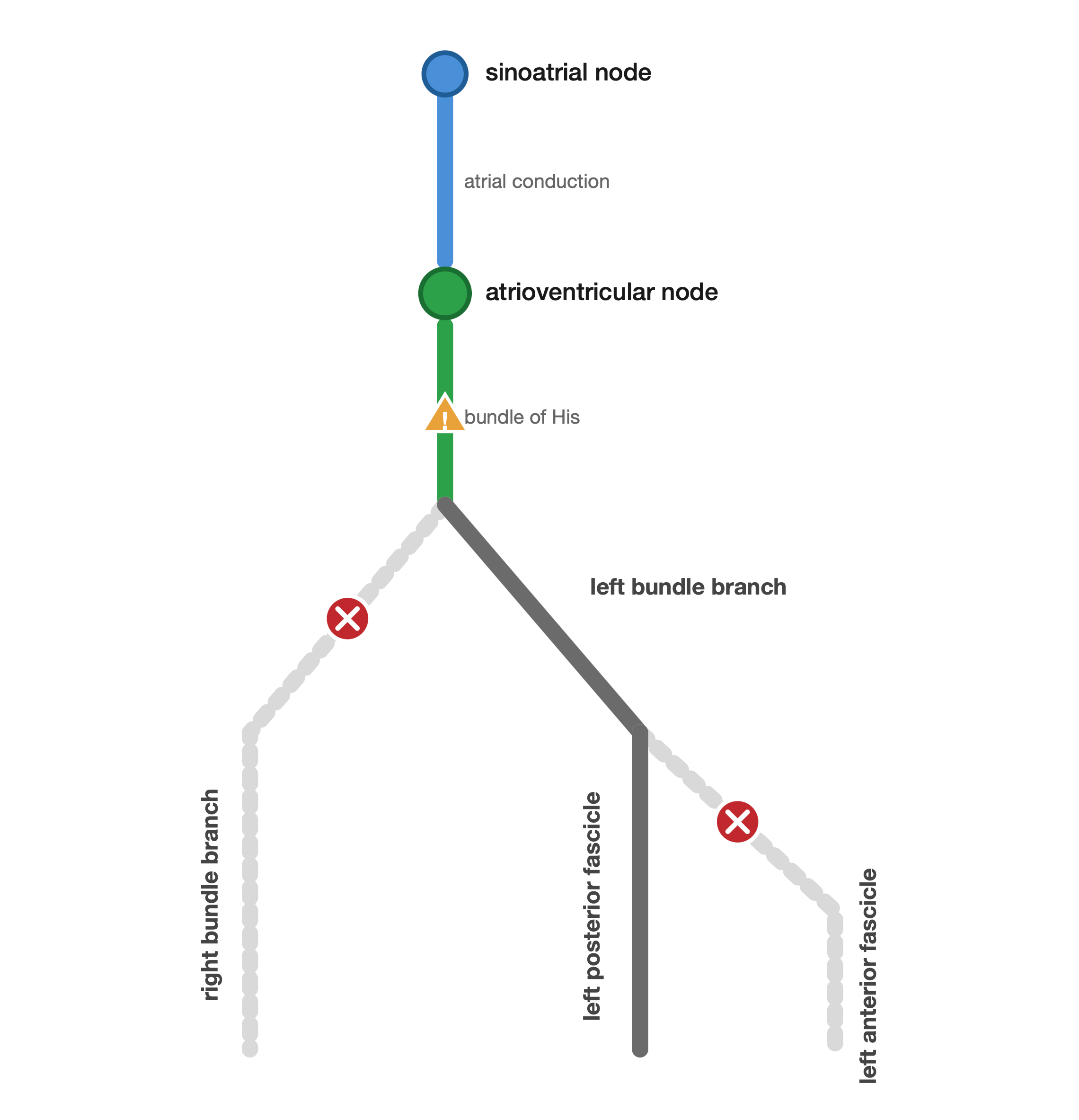
LBBB is worth pausing on. Because the left bundle splits into the two left fascicles, complete LBBB implies block in both. Functionally, it is already a bifascicular block.
In two branches at once (bifascicular block):
RBBB with LAFB (the common pairing)
RBBB with LPFB (rarer)
LBBB on its own (both left fascicles)
In all three branches:
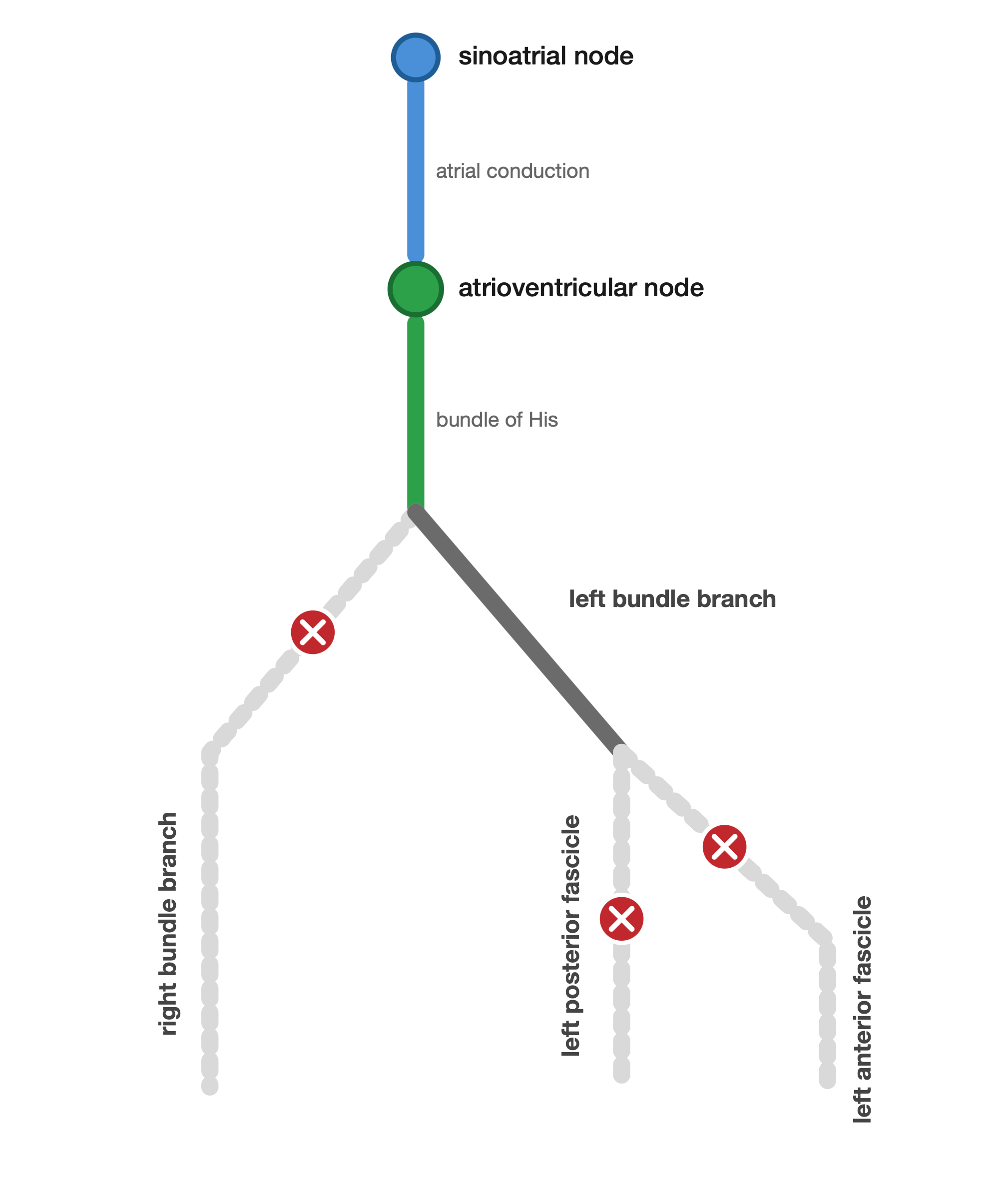
Simultaneously: no impulse reaches the ventricles through the normal conduction system. What you see is complete AV block with an infranodal (fascicular or ventricular) escape rhythm.
Sequentially over successive beats: alternating bundle branch block. RBBB on one beat, LBBB on the next; or RBBB + LAFB on one beat, RBBB + LPFB on the next. Each beat reveals a different branch carrying the conduction load while the others are blocked.
Combinations of nodal and infranodal disease. Any degree of AV block can coexist with any bundle or fascicular block. The findings are independent. The QRS width and morphology tell you about the bundle branches and the fascicles; the PR interval and P:QRS pattern tell you about the AV junction (AV node and His bundle).
What people mean when they say trifascicular block
Meaning 1: bifascicular block with 1st degree AV block. The bedside usage. The one in textbooks and exam stems. The logic feels intuitive: two fascicles are blocked, the PR is long, so the third fascicle must be conducting slowly.
The flaw is in the last step. The AV node is not a fascicle. A long PR can come from the AV node, from below the His, from both, or even from an atrial conduction delay.
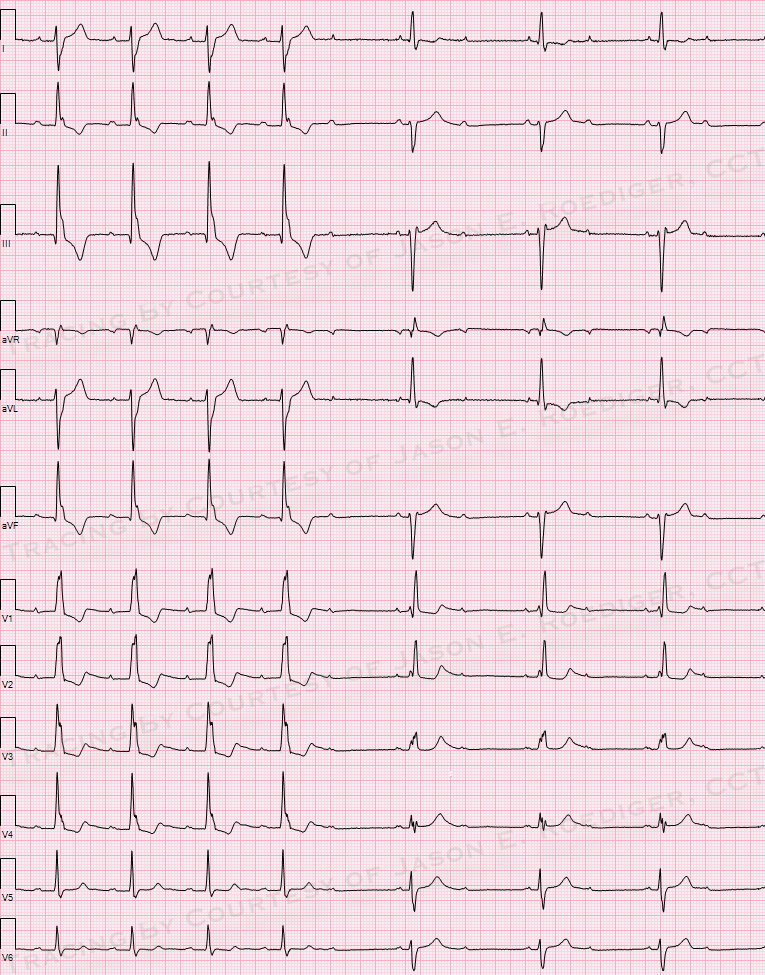
Meaning 2: alternating bundle branch block. The QRS morphology changes on successive beats. RBBB then LBBB, or RBBB + LAFB then RBBB + LPFB. Each beat demonstrates a different branch conducting while the others are blocked. This is the one ECG finding that proves all three branches are diseased, and it does so without inference.
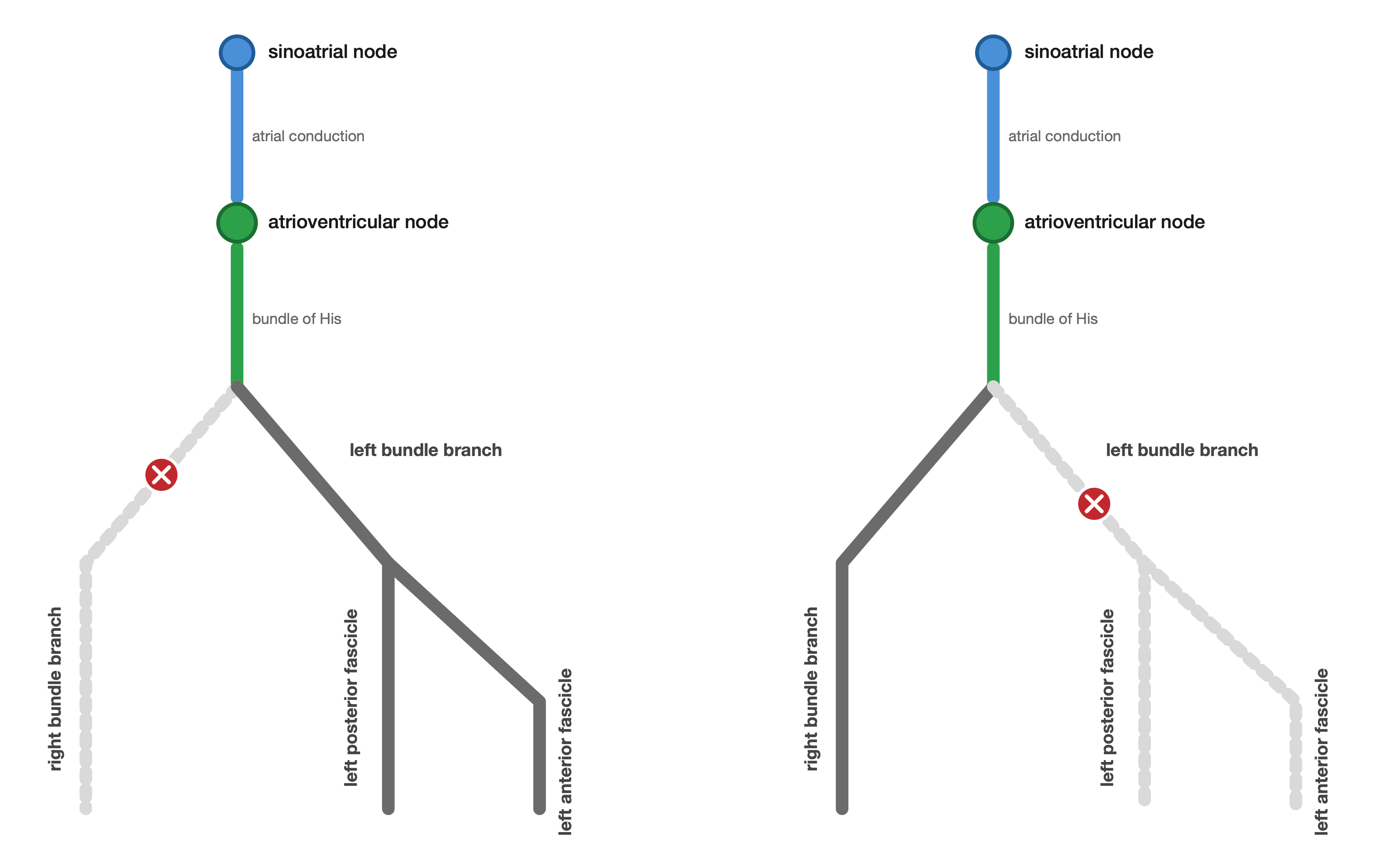
Meaning 3: simultaneous block in all three branches. The strict, anatomical reading. If it happens, no impulse from the atria reaches the ventricles through the normal conduction system, and the ventricles depend on an infranodal escape. This is a real entity. We already have a name for it: complete heart block with an infranodal escape rhythm.
Three meanings. Same words. This is why the only safe reply, when someone says “trifascicular block” in a ward round, is another question:
“When you say trifascicular block, you mean…?”
Summary
“Trifascicular block” is used for at least three different ECG findings:
bifascicular block with 1st degree AVB
alternating bundle branch block
complete AV block with an infranodal escape.
The 2009 AHA/ACCF/HRS committee recommended abandoning the term and describing each conduction defect separately [1].
Write what you see: “RBBB with LAFB plus 1st degree AV block”, “alternating bundle branch block”, or “complete heart block with an infranodal escape”.
References
Surawicz B, Childers R, Deal BJ, Gettes LS. AHA/ACCF/HRS Recommendations for the Standardization and Interpretation of the Electrocardiogram: Part III: Intraventricular Conduction Disturbances: A Scientific Statement From the American Heart Association Electrocardiography and Arrhythmias Committee, Council on Clinical Cardiology; the American College of Cardiology Foundation; and the Heart Rhythm Society. J Am Coll Cardiol. 2009;53(11):976-981. doi:10.1016/j.jacc.2008.12.013
One of the most resonant educational pieces on ECG interpretation I have ever read. It takes a term that has generated confusion for decades and clarifies it with remarkable precision. It demonstrates how precise language improves clinical thinking and, ultimately, patient care.
I am getting a pacemaker for AV block mobitz II with two leads. The device can be extended in situ to a third lead. I figure one lead will do to the sinoatrial node. Where does the second go?