
"I feel fine, doctor" | ECG challenge #11
A 62-year-old man with poorly controlled hypertension has a routine ECG.

The case
A 62-year-old man attends his GP surgery for a routine hypertension review. He has a history of hypertension treated with amlodipine 10 mg once daily and type 2 diabetes mellitus. He is asymptomatic.
On examination, his pulse is 88 bpm and regular, and his blood pressure is 164/98 mmHg. Heart sounds are normal with no added sounds.
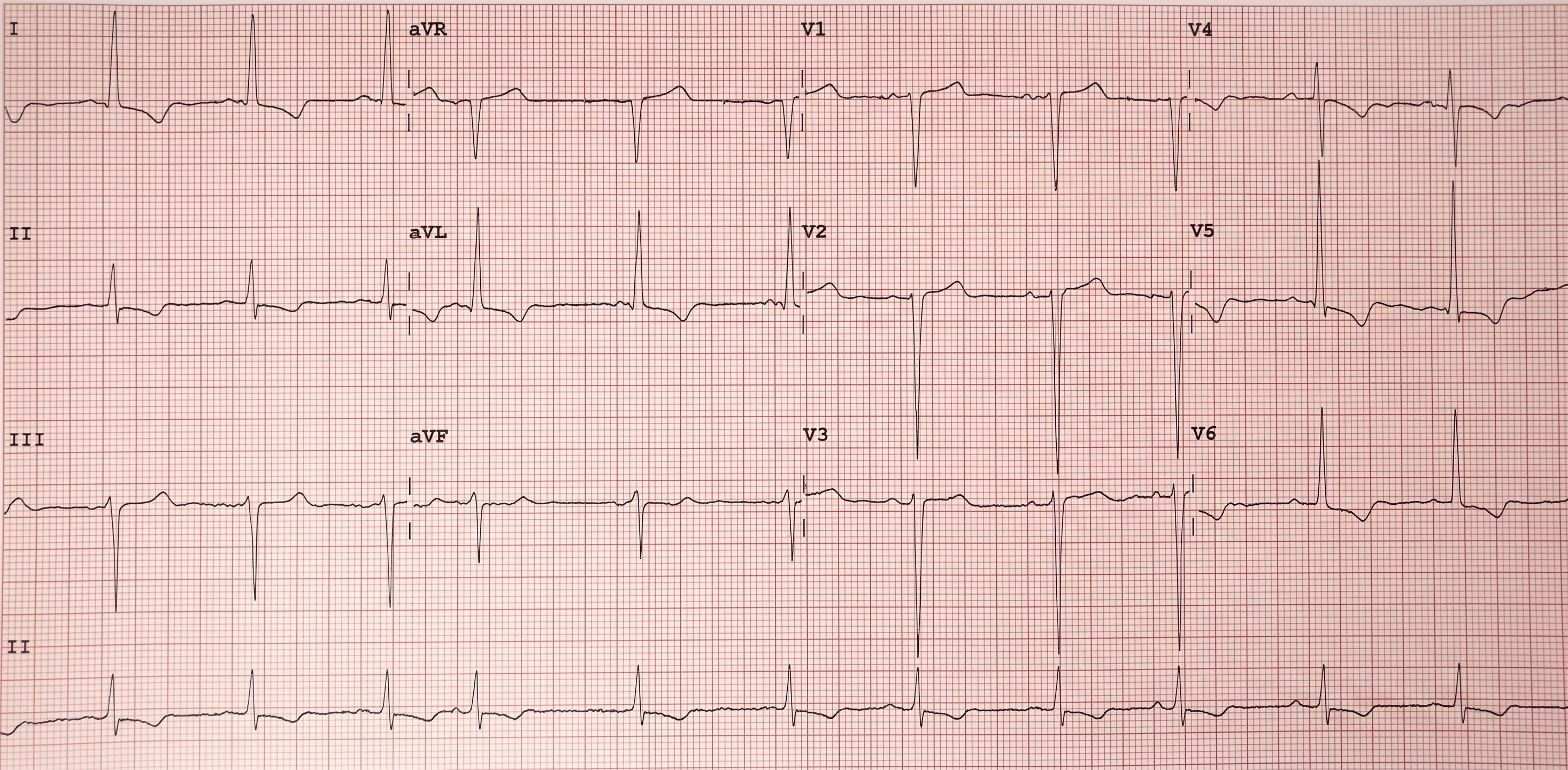
A 12-lead ECG is performed.
ECG systematic analysis
Assumed paper speed: 25 mm/s and voltage: 10 mm/mV (standard).
This ECG shows the following:
Rhythm: Sinus arrhythmia with one premature atrial complex (PAC) (4th beat), followed by a non-compensatory pause.
P waves: Normal morphology and axis (upright in lead II, negative in aVR). Rate ~90 bpm.
PR interval: 160 ms (normal).
QRS complex:
Rate: ~90 bpm.
Duration: Narrow (less than 120 ms).
Axis: Normal (positive in leads I and II).
Morphology: Tall R waves in V4-V6 (R in V5 = 22 mm). Deep S wave in V1 (15 mm). No bundle branch block pattern.
QT interval: QTcB 440 ms (within normal limits).
ST segment: 0.5 mm ST depression in leads I, aVL, II, V5-V6.
T waves: T-wave inversion in leads I, aVL, II, and V4-V6.
Overall, this ECG shows sinus arrhythmia with one PAC and high QRS voltage meeting criteria for left ventricular hypertrophy. The Sokolow-Lyon index (S in V1 + R in V5 = 15 + 22) is 37 mm (threshold >= 35 mm). The Cornell voltage (R in aVL + S in V3 = 15 + 25) is 40 mm (threshold > 28 mm in men). The ST depression and T-wave inversion in the lateral leads represent a strain pattern.
Correct answer
Hypertension
The ECG shows left ventricular hypertrophy (LVH) with a strain pattern. The most likely cause is this patient’s poorly controlled hypertension.
LVH means the left ventricle has more muscle mass than normal. When the heart contracts against chronically elevated afterload (as in hypertension), the left ventricular wall thickens in response. This is concentric hypertrophy: the wall gets thicker, but the chamber size stays the same [1]. Every ECG feature follows from the increased muscle mass.
The QRS complex represents the sum of all ventricular depolarisation vectors. In a normal heart, the left ventricle already dominates because it has far greater mass than the right ventricle. The net vector points leftward, towards V5 and V6, producing tall R waves in those leads and a deep S wave in V1. In LVH, more myocytes firing in the same direction amplify this vector. The R waves in V5 and V6 grow taller. The S wave in V1 grows deeper. This is what voltage criteria detect:
Sokolow-Lyon index: S in V1 + R in V5 or V6 >= 35 mm. This ECG: 37 mm.
Cornell voltage: R in aVL + S in V3 > 28 mm (men) or > 20 mm (women). This ECG: 40 mm.
The ST depression and asymmetric T-wave inversion in the leads facing the hypertrophied ventricle represent the strain pattern: a repolarisation abnormality seen in hypertrophied myocardium. The T-wave inversion is asymmetric (gradual descent, sharp upstroke), most prominent in the lateral leads (I, aVL, V5-V6) but often extending to other leads (such as lead II here) when hypertrophy is marked. The strain pattern increases diagnostic specificity when combined with voltage criteria [2].
This patient’s blood pressure is 164/98 mmHg despite amlodipine, confirming poorly controlled hypertension. Hypertension is the most common cause of pathologic LVH [1].
Incorrect options
Amlodipine.
Amlodipine is a calcium channel blocker used to treat hypertension. It does not cause LVH or the ECG changes seen here. If anything, by reducing afterload, antihypertensive treatment helps prevent and even reverse LVH. The ECG findings are caused by the underlying condition (hypertension), not its treatment.
Aortic stenosis.
Aortic stenosis is a genuine cause of LVH: the left ventricle hypertrophies in response to increased afterload from the narrowed valve. However, significant aortic stenosis produces an ejection systolic murmur, typically heard loudest at the right upper sternal edge with radiation to the carotids. This patient’s heart sounds are normal with no added sounds, making aortic stenosis unlikely. This option rewards careful reading of the examination findings.
Diabetes mellitus.
Type 2 diabetes is a cardiovascular risk factor and is associated with diabetic cardiomyopathy, but it does not directly cause the high voltage pattern of LVH seen on this ECG. The tall QRS voltages and strain pattern reflect increased left ventricular muscle mass from chronically elevated afterload, which is best explained by the poorly controlled blood pressure.
Ischaemic heart disease.
The ST depression and T-wave inversion in the lateral leads can superficially resemble myocardial ischaemia. However, the T-wave inversion here is asymmetric (gradual descent, sharp upstroke), accompanies high QRS voltage, and is present across multiple lateral leads simultaneously. This is the strain pattern of LVH, not ischaemia. Ischaemia typically produces symmetric T-wave inversion that evolves over time and follows a coronary territory distribution. The patient is also asymptomatic, making acute ischaemia unlikely.
Why does LVH matter?
LVH is present in 15 to 20% of the general population and is an independent risk factor for cardiovascular morbidity and mortality, including a predisposition to atrial fibrillation [1].
Confirm with echocardiography. The ECG identifies possible LVH; the echocardiogram confirms it, quantifies the degree of hypertrophy, and distinguishes concentric from eccentric hypertrophy [1].
Treat the underlying cause. LVH can be reversible. The LIFE study demonstrated that LVH regression with antihypertensive treatment improved cardiovascular outcomes independently of blood pressure reduction [1]. Optimising this patient’s blood pressure control could reverse the structural change in his heart.

Summary
How to identify LVH on a 12-lead ECG:
High QRS voltage. Tall R waves in the lateral leads (V5, V6, I, aVL) and deep S waves in V1-V2. Check Sokolow-Lyon (S in V1 + R in V5 or V6 >= 35 mm) and Cornell (R in aVL + S in V3 > 28 mm in men, > 20 mm in women).
Strain pattern. ST depression with asymmetric T-wave inversion in the lateral leads. Gradual descent, sharp upstroke. Do not mistake this for ischaemia.
Normal QRS duration. The QRS is tall but narrow (unlike LBBB, where it is wide).
Clinical context. LVH on ECG in a hypertensive patient fits. Confirm with echocardiography.
References
Bornstein AB, Rao SS, Marwaha K. Left Ventricular Hypertrophy. StatPearls. 2023 Aug 8.
Edhouse J, Thakur RK, Khalil JM. Conditions affecting the left side of the heart. BMJ. 2002;324:1264-7.